Generating portfolio for Alfie Martin...
35%
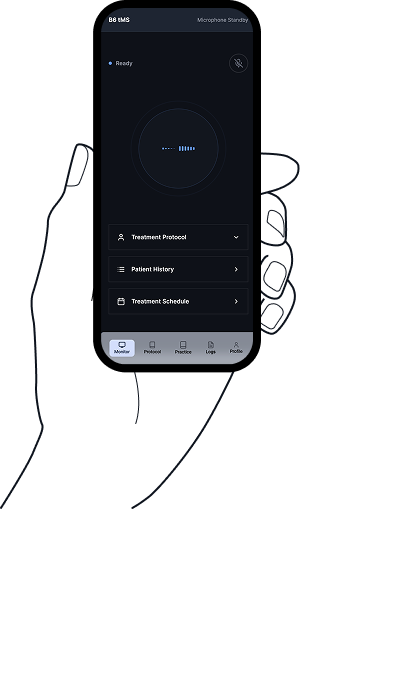
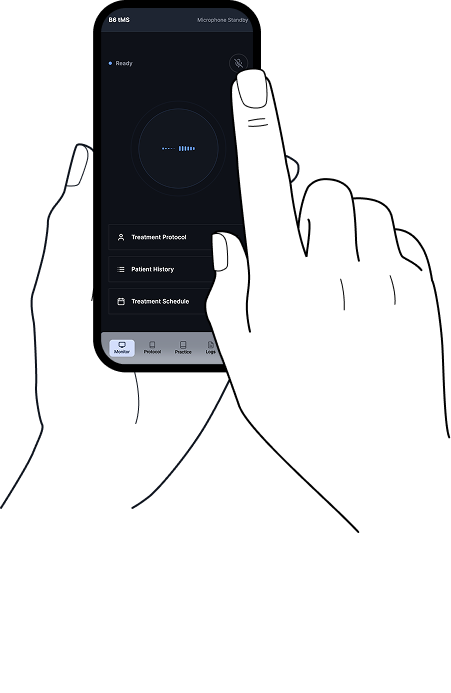
Exploring fluid interfaces.
In my opinion, conversational design is similar to choreography. You're designing a dance between a human and a machine, where neither one fully controls the music. My job is to make the machine a good enough dance partner that the human never feels stepped on.
Every conversational experience, regardless of modality, has the same underlying structure in simple terms:
- The user has intent — they want something done, answered
- The system must recognize that intent — through voice, text, gesture, or context.
- The system responds — with words, actions, visuals, or silence.
- The conversation advances or repairs — the dance continues, or someone stumbles and recovers.
My job is to juxtapose all four of these moments across every path a conversation can take, the happy paths, the confused paths, the frustrated paths, and the paths nobody predicted.
AI Conversational Design
My approach is to design for error states first. In conversation, misunderstanding is the norm. Around 30-40% of conversational turns involve some form of repair, clarification, or renegotiation. Designing "The happy path" dialogue is roughly a third of the work. The rest, and most important, is figuring out what happens when the system doesn't understand, when the user changes their mind mid-task, when context shifts, or when confidence is low.
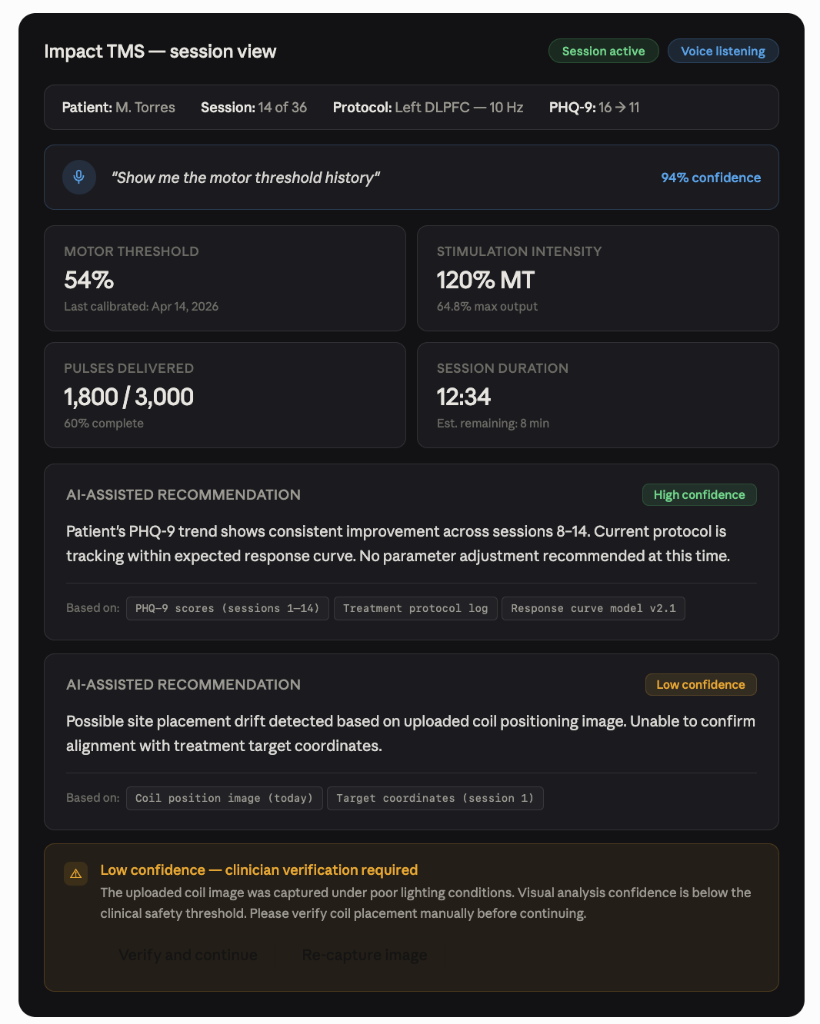
Multimodal channel architecture.
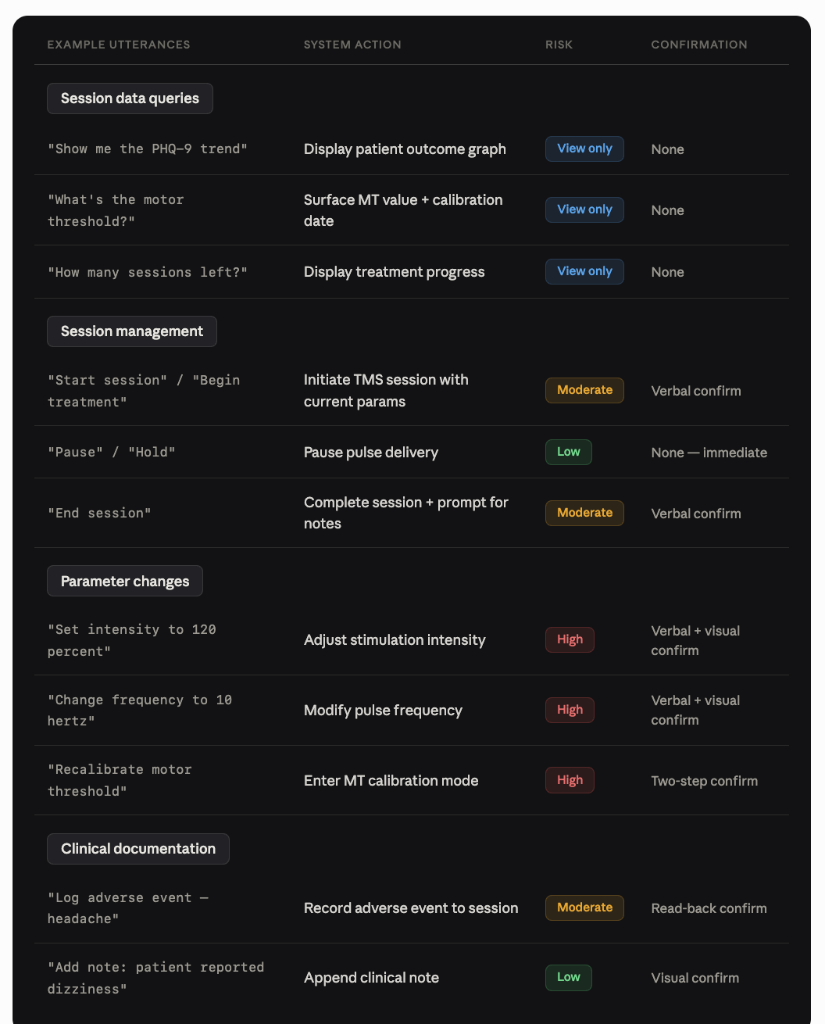
Intent mapping diagram.
Glossary
Entity
A recognized real-world object or concept within user input (e.g., dates, locations, names).
Confidence Score
A probabilistic measure indicating how certain a model is about its classification or generated output.
Latency
The time delay between a user's input and the system's response. Critical for conversational interfaces.
Guardrails
Hardcoded rules or secondary models designed to constrain AI behavior, preventing unsafe or off-topic outputs.
RAG (Retrieval-Augmented Generation)
Enhancing LLM responses by dynamically retrieving relevant facts from an external knowledge base before generating text.
Recall
The fraction of relevant instances that were actually retrieved or identified by the model.
Precision / Recall Tradeoff
The balance between being strictly accurate (precision) and capturing all possible positive matches (recall).
F1 Score
The harmonic mean of precision and recall, often used as a single metric to evaluate overall classification accuracy.
Multimodal
Systems capable of processing and understanding multiple types of input concurrently, such as text, voice, vision, and touch.